Showing posts with label poetry. Show all posts

The Swan

Posted by Expert Gadget Reviewer on Tuesday, 31 May 2011


The Swan


Just as Blake engraved his poems backwards,
out of necessity but also open-mindedness,

each illuminated word gleaming in relief
against its brightly burning backdrop,

something clicked into place
as we watched it hurtling upwards:

the desperate, beating wingspan
testament to what should or could or can

be achieved when all’s open, flung wide,
neck craned out and eyes on the prize

as, thrashing itself from the lake’s surface,
its flight was a realised extravagance –

as Blake, man of genius and boy of visions,
saw angels line the trees, beyond reach of metaphors.


poem by Ben Wilkinson; first published in The Sparks (tall-lighthouse, 2008)
More about → The Swan

Review: Colette Bryce's Self-Portrait in the Dark

Posted by Expert Gadget Reviewer on Monday, 30 May 2011


Often as it might be said of first collections, Colette Bryce’s The Heel of Bernadette (2000) was a debut of genuine and considerable promise: its taut, economic lines combining everyday vernacular with deftly crafted images and a winning, often unusual musicality, to produce, in its finer moments, poems that were both intellectually provocative and formally agile. It suggested that a more mature and potentially brilliant second collection might follow, but for all its qualities – the poems’ stylish lines, their verve and meticulous execution – its follow-up, The Full Indian Rope Trick (2004), offered little in the way of real surprises, tending to reiterate (with a few notable exceptions) the winsome effects of Bryce’s earlier work.

‘A Spider’, the opening vignette of Self-Portrait in the Dark, quickly and quietly suggests that this new book will be, in at least certain respects, different. A sketch that takes the act of ‘trapp[ing] a spider in a glass’ as symbolic of the narrator’s own circumstances, the tight lines and subtle music of earlier poems are still in evidence, but Bryce makes these resources work harder than previously: manipulating syntax and repetition to conjure a well-pitched tone and convincing atmosphere (‘a glass, / a fine-blown wineglass. / It shut around him, silently’), while pushing her rhyming panache to achieve surprising metaphorical links:

I meant to let him go
but still he taps against the glass
all Marcel Marceau
in the wall that is there but not there,
a circumstance I know.


The effect is an impressive one. Bryce has the knack of making her poems look effortless when a restless intelligence is carefully at work behind them. But it’s when this hard thinking is combined with the looser lines of lengthier poems that the results are most pleasingly unusual and memorable. In ‘The Residents’, for instance, stanzas of slant-rhymed couplets are adopted to describe an eerie, dust-ridden study where ‘mould is blossoming on the wall’; a ‘funk-hole’ which seems to embody the anxiety of literary influence (note the Yeatsian refrain at the end of each stanza) as well as the writer’s fear of failure, especially when its richly described, dilapidated state becomes a reimagining of the room as a crime scene, where

if asked, you could offer a team from forensics:
– various punched-out blister packs
– a fingerprint in a lip-gloss compact
– a half-smoked menthol cigarette
– a woollen scarf unravelling on a hook
– a mildewed draft of her second book
– a culture thriving in her unwashed cup
– a single plimsoll, size five, lace-up […]

An almost darkly comic meditation on the nature of both the literary life and the decidedly contemporary enterprise of the literary residency, the poem goes on to end with these curious and suggestive tangents (‘posit[ing] a case of human combustion / perhaps, or an extra-terrestrial abduction’) cutting suddenly short: ‘skip[ping] three years / to a bright young novelist opening the door; / the inaudible snap of a spider’s thread / as he takes the first steps into your head.’ It succeeds – as in the sudden closure of the final end-rhyme – when the tone is pitched between indifference and a sense of resignation and regret, interrogating the speed of twenty-first century life as it affects writers, readers and literature itself, but also the feeling that much of our world is increasingly disposable and that nothing, not even literature (‘Is this a crime scene? Is it a shrine?’) is ever quite sacred.

Another commendable feature of this new book is its well-judged humour. In the title poem, for example, the narrator’s talk of insomnia, smoking habits and ‘moving on’ from a difficult break-up is smartly juxtaposed with wryly amusing observations: ‘Here, I could easily go off / on a riff / on how cars, like pets, look a little like their owners / but I won’t ‘go there’, / as they say in America, / given it’s a clapped-out Nissan Micra…’ So too, with greater subtlety, in ‘The Poetry Bug’: ‘a moon-pale, lumpish creature’; and the two women in ‘Car Wash’, kissing ‘in a world where to do so / can still stop the traffic.’ Bryce’s wide thematic range is also striking, even if the results are not always successful: ghosts, empty cars, mobile phones, mysterious dwellings and vivid childhood memories recur throughout the collection in poems that are frequently shrouded by cigarette smoke or a strange half-light. A particular highlight is the intricate conceit of ‘Volcanoes’, where the human imagination and the workings of the earth begin to mirror and merge: ‘The mind in the cavern of the skull. / The skull the limits of the skies. / The core in the dark behind the eyes.’

There are reasons to suspect, however, that the renewed depth, wit and imaginative range of Self-Portrait in the Dark may go unmentioned, even unnoticed, by some critics and readers, and this is largely due to the combination of Bryce’s succinct and swift-moving poetic style with the difficulty of uncovering the sometimes elliptical significance of her work. Starting this review with two relatively close readings of Bryce’s poems was an attempt to offset this – the notion that fluent, musical and energetic contemporary poems yield their meanings quickly and cleanly without warranting a great deal of rereading or deliberation. For while there are poems in this book which seem a tad hurried and glib (‘The Knack’; ‘On Highgate Hill’), the majority see Bryce developing a muscular and graceful language capable of dealing with everything from the grander themes (the solitude of ‘Finisterre’; the failures of language in ‘Sin Música’) to the specifics of contemporary life (the junk inside a phone box in ‘Belfast Waking, 6 a.m.’; the detailed introspection of ‘Self-Portrait in a Broken Wing-Mirror’). Reading this book through for the first time is something of a mixed experience, but if the poems are given the time and thought they deserve, Self-Portrait in the Dark reveals itself to be a complex and often richly rewarding volume.


first published in Stand magazine
More about → Review: Colette Bryce's Self-Portrait in the Dark

The Salt Book of Younger Poets

Posted by Expert Gadget Reviewer on Thursday, 21 April 2011


THE SALT BOOK OF YOUNGER POETS
edited by Roddy Lumsden & Eloise Stonborough
Salt Publishing, October 2011. Paperback, £10.99


The Salt Book of Younger Poets showcases a new generation of British poets born since the mid-80s. Many of these poets embrace new technologies such as blogs, social networking and webzines to meet, mentor, influence and publish their own work and others’. Some poets here were winners of the Foyle young poet awards when at school. Some have published pamphlets in series such as tall-lighthouse Pilot and Faber New Poets. All of them are working away on first collections. This is a chance to encounter the poets who will dominate UK poetry in years to come.


Rachael Allen | Daniel Barrow | Jack Belloli | Jay Bernard | James Brookes | Phil Brown | Niall Campbell | Kayo Chingonyi | Miranda Cichy | John Clegg | Nia Davies | Amy De’ath | Inua Ellams | Charlotte Geater | Tom Gilliver | Dai George | Emily Hasler | Oli Hazzard | Dan Hitchens | Sarah Howe | Andrew Jamison | Annie Katchinska | Andrew McMillan | Siofra McSherry | Ben Maier | Laura Marsh | Annabella Massey | James Midgley | Helen Mort | Charlotte Newman | Richard O’Brien | Richard Osmond | Vidyan Ravinthiran | Sophie Robinson | Charlotte Runcie | Ashna Sarkar | William Searle | Colette Sensier | Warsan Shire | Lavinia Singer | Adham Smart | Martha Sprackland | Eloise Stonborough | Emily Tesh | Jack Underwood | Ahren Warner | Ben Wilkinson | Sophie Yeo


Available to pre-order from Amazon.

More about → The Salt Book of Younger Poets

Fiere

Posted by Expert Gadget Reviewer on Saturday, 12 February 2011


Just a quick note for those interested: my review of Fiere, Jackie Kay's new book of poems and her first with Picador, appears in today's Guardian Review. It's also on Guardian.co.uk. Brief pieces from previous supplements - on books by David Wheatley, Anna Woodford, Brian Turner, John Haynes, Penelope Shuttle, and Dan Wyke - are also in the poetry reviews archive, here.
More about → Fiere

Bearing

Posted by Expert Gadget Reviewer


Bearing


Watching him that spring-spilled-into-summer,
sat among Algar Seco’s jagged rocks,
steadfast with rod, tub of bait,

water, hunk of bread,
still and magisterial as a stork in its nest
settled above the walls of Silves,

I recovered what it was to wait –
content, not out of hope or faith
but for the catch that always comes;

a clutch of silver by dusk just as
us, stumbling onto the beach one night,
finding that added depth in each other’s eyes.


Ben Wilkinson
More about → Bearing

Lament

Posted by Expert Gadget Reviewer on Monday, 15 November 2010


Lament


Here now, it’s hard to believe this place –
yellowed wallpaper, towels hung over
every decent lager except the guest –
is where we first met and that blur

of brilliance – a world from this pint
and the torn fabric of a duff pool table –
meant the next week, the next fortnight,
were the closest things ever get to simple.

So if this is how I know us, want us –
the two who clicked on an understanding
of close as close to sparseness, bluntness –
then that’s why, aware or drifting,

I’ve come to sit in this selfsame chair,
selfsame spot; listening to the traffic
which you must be a part of, somewhere,
pitched as it is among frantic and Orphic

while one by one the pigeons flutter off;
draining the glass and closing my book
as the lights click on, someone coughs,
and the place is good as lost, however I look.


Ben Wilkinson
More about → Lament

Katharine Towers: The Floating Man

Posted by Expert Gadget Reviewer on Wednesday, 15 September 2010

I've been looking forward to the appearance of Katharine Towers's first collection of poems for some time now, having come across her work in a pamphlet, Slow Time, a few years back; a striking little volume for its poems' economical and unshowy resonance. So it was a pleasant surprise to spot the title poem from her debut with Picador, The Floating Man, in the Guardian the other month, and to see her collection longlisted for the Guardian First Book award. Even more so, it was a pleasure to write at length on the collection for that publication; my review of The Floating Man, appearing as it did, in last Saturday's Guardian Review. For those interested, it's also available to read online. And after you've been suitably persuaded, you can order a copy of the book, a snip at 25% off the cover price.
More about → Katharine Towers: The Floating Man

Faber Firsts, Poetry Classics & Poet to Poet on special offer

Posted by Expert Gadget Reviewer on Thursday, 5 August 2010

There's a lot to be said for brilliantly designed and stunningly produced books, second fiddle though these things are - and certainly should be - to brilliant, stunning writing. When the two are combined, though, the book lover really can't ask for much more. And so it is with these recent Faber Firsts reissues: beautiful, highly affordable hardbacks of classic contemporary collections, including Armitage's Kid, Cope's Making Cocoa for Kingsley Amis, Paterson's Nil Nil and Larkin's The Whitsun Weddings.


They seem a continuation of the beautiful Faber 80th Anniversary Poetry Classics, selected poems of various poets which include similarly stunning designs and not only make the perfect gift for the newcomer to British and Irish poetry, but are tempting to those of us who already own other, doubtlessly less stylish, selecteds of Yeats, Plath, Hughes, Auden, Betjeman and Eliot.


Good news, then, for those of us who live in or around Sheffield, as the Blackwell Bookshop on Mappin St (just off West St) has the poetry section bursting with these, and all on offer at 3 for the price of 2, alongside a healthy selection of titles from the Poet to Poet series, also 3 for 2, all of which contain an illuminating introduction and selection from a great poet's work by a contemporary (I especially recommend Michael Hofmann's John Berryman, Maurice Riordan's Hart Crane, and August Kleinzahler's Thom Gunn). As Tony Williams puts it: "I covet the books even though I already own other editions".
More about → Faber Firsts, Poetry Classics & Poet to Poet on special offer

Blackbox Manifold and Ink, Sweat & Tears

Posted by Expert Gadget Reviewer on Tuesday, 3 August 2010


The fifth issue of literary ezine Blackbox Manifold has just been published, and well worth reading it is too; the usual mix of big names and new voices and poems of all styles, subjects and schools. And so you can read new work from George Szirtes, Sharon Olds, Vidyan Ravinthiran, Carolyn Hart and Susan Wicks, among others. I've a couple of poems included, too. There are also reviews by Vahni Capildeo, an exciting young poet in her own right (check out her stuff in Roddy Lumsden's recent generational anthology, Identity Parade), and by Adam Piette, co-founder and editor of the magazine.

Also worth checking out is the prose and poetry forum Ink, Sweat & Tears, which features a new poem, piece of prose writing or visual artwork almost every day. Recent highlights include Helen Mort's 'The Lovesick', which somehow manages to conjure genuine emotion from a Carry On scene, Helen Ivory's amusing account of her time at Latitude Festival, and Dan Wyke's atmospheric 'Saturday Night in St Ives'. Yesterday, my short version of Eugenio Montale's 'Il Balcone' also appeared there: an absolutely beautiful short poem in the original Italian I'm told. I at least hope I've captured its general feel. In any case, do drop in on the zine's site from time to time: there's sure to be plenty more fascinating stuff added in the future.
More about → Blackbox Manifold and Ink, Sweat & Tears

The Burning Perch

Posted by Expert Gadget Reviewer on Tuesday, 13 July 2010

A snappy - and hopefully accessible and informative - piece on Louis MacNeice's best and last collection, The Burning Perch, features in the second issue of YM, the Poetry Society's online magazine for new young readers and writers of poetry. Do take a look, and once you've been persuaded, you can pick up the excellent Collected Poems here.
More about → The Burning Perch

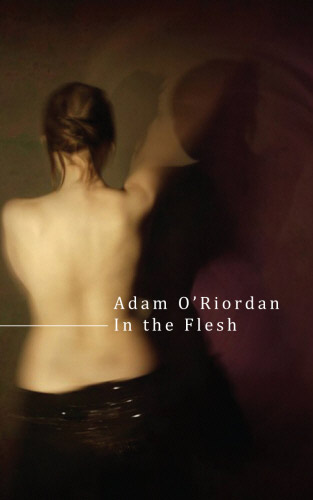
Adam O'Riordan, In the Flesh

Posted by Expert Gadget Reviewer on Sunday, 6 June 2010


This year looks like it’s shaping up to be an interesting one for new British poetry. There are several exciting debuts that have recently been released or are shortly forthcoming, not least Sam Willetts’s New Light for the Old Dark, which I mentioned here a couple of months back, Miriam Gamble’s The Squirrels are Dead, a first book of rhythmically taut poems that, if the stuff of hers I’ve spotted in magazines and elsewhere is anything to go by, will include lyrics and narratives from animal and curiously alien perspectives, and, of course, Dan Wyke’s long awaited debut with Waterloo, whose subtly suggestive poems address the domestic, familial and everyday with knowing insight.

One book I’m particularly looking forward to, though, is the first full collection from Adam O’Riordan. Titled In the Flesh and due to appear from Chatto & Windus this July, it follows on from a pamphlet, Queen of the Cotton Cities, published by tall-lighthouse in 2007 as one of the first in its acclaimed Pilot series, and winner of an Eric Gregory Award. A short volume of only sixteen poems, this pamphlet was the first introduction readers got to O’Riordan’s work, but it leaves a lasting impression: lyrical, thematically wide-ranging and Donaghy-like in its formal panache, the poems combine dazzling metaphor and simile with sudden shifts in perspective and detailed, provocative contemplation.

Having read an early proof, I’d certainly say that In the Flesh builds on this early promise, including many new longer poems and a sequence of sonnets, ‘Home’, which imagine episodes from the lives of William and Dorothy Wordsworth, inspired by O’Riordan’s time as the Wordsworth Trust’s Poet-in-Residence at Dove Cottage. On the strength of the collection taken as a whole, I’m even inclined - for once - to agree with the publisher’s hype, which describes O’Riordan’s poems as “confident, seductive, and thrillingly assured […] seeking familiarity in a world of ‘false trails and disappearing acts’ […] in language both clear-eyed and sensuous”. Adding to that list of superlatives, I’d also call his stuff jaunty, vibrant, and satisfyingly disorienting: take vignette ‘NGC3949’, below, as an example of his ability to marry incongruous subjects in atmospheric and convincing conceits. And since it's often interesting to hear a writer's own thoughts about their work, as well as a bit of background, Adam answers a couple of questions below.


NGC3949

is a galaxy in Ursa Major whose formation mirrors, almost exactly, that of our own.


Back from the perforated dark and growing distance,
Hubble’s milky image brings us to ourselves.

The echo pitched up from the moss-wet well:
a lover’s shape, that indelible stain on the iris.

(Years down the line, you swear blind
the cut and sway of a dark form is her.

Neon dazzles the rain-slicked street
as you wave away the cab and push

back down through the crowd into the bar,
pilot charting the wrong star by candlelight,

leagues off course, the face, of course, is another’s.)
In this spiral galaxy the arms embrace the core.

Not her – or your idea of her – and never will be.
It doesn’t matter how beautiful your guess is.


© Adam O'Riordan, reproduced by permission of the poet


BW: One of the first things readers will notice about In the Flesh is a strong sense of place threaded through the collection: Manchester, the Lake District, specific locations such as a college window in Cambridge or an escalator in Paris. Can you tell us a little about your background, upbringing, and what we might call your 'imaginative hinterland', and how you see these as contributing to your writing?

AOR: I was born in Didsbury in South Manchester.

My father’s family were from Scotland. His father was a third generation Irish immigrant and the third generation in public service, in his a case as a career naval officer. His mother from Fife, what you might call, haute-bourgeoisie. She was a descendant of Sir Michael Nairn, the linoleum manufacturer who took his father’s floor-cloth business and industrialized the process.

My mother’s family were a mix English, Scottish, and Irish. Her father’s family had come down from Aberdeen where they worked in the fisheries to work in the newly built Trafford Park, the world’s first planned industrial estate. Family legend has it they sailed down on board a fishing boat during the herring famine.

My father worked in Trade Union education, in fact he met my mother when they both at the same college. They were both active in the Labour party and for a period my mother ran the office of our local MP.

I was the first generation on my father’s side to go to a State school, but the fourth or fifth to go to Oxbridge.

I suppose these factors made me acutely aware of class and identity but also the fluidity of both. Leaving me feeling not particularly at home, or too uncomfortable, in any.

I remember my father telling me about an exercise called ‘Dig Where You Stand’ from a book of the same name by a Swedish historian Sven Lindqvist which encouraged workers to re-discover their history.

My poem ‘A Trade Union College’ from the ‘Vanishing Points’ sequence recalls a story my father told me about teaching a group of shop stewards as a young man and carrying out the exercise. Part way through he realized that the college they were in had once been a rather grand private house and was the place his mother was born. Though apparently they didn’t give him too hard a time about it.

The other poems in the sequence looks at similar themes – flux and change and forgetting of identity. The poem ‘A Wedding Letter’ takes a note written by the son of my last Gaelic speaking ancestor on the night of his daughter’s wedding in 1906. He describes in a wonderfully Edwardian way how she ‘would carry her hospitality to extravagance’ and ‘never spoke English with any satisfaction’.

It occurred to me in reading the letter that once it was lost or forgotten that the woman (my great great great grandmother) would vanish. It was that chilling sense of erasure coupled with the privilege of being perhaps one of the last to catch a glimpse of her in that description.


BW: That title, In the Flesh, captures well the blurrings between the sensual and the violent, the physically beautiful and the rawly animal, which much of your work centres on. Do you see this as an especially contemporary concern?

AOR: I think it’s always been there. Certainly in the lines and traditions I respect and have learned from: think of Yeats’s Leda and the Swan with that ‘’sudden blow / the great wings beating still’.

I always loved that line in Romeo and Juliet where Mercutio, in a lovely coupling of the two, describes Tybalt as ‘the very butcher of a silk button’.

I remember when I was in residence at The Wordsworth Trust showing my collection in progress to Pamela Woof, the president of the Trust and academic. She wrote a note to me talking about ‘the nearness of violence to beauty, of beauty to the vulnerable’ which I think captures it.

I struggled with the title for a long time. I wanted something that suggests not just the blurrings of sensual and violent you mention but also a sense of presence and absence and the familia. I think ‘In the Flesh’ ties it all together quite well.
More about → Adam O'Riordan, In the Flesh

Recent Issues

Posted by Expert Gadget Reviewer on Tuesday, 25 May 2010

Well, here are a few recent issues of magazines that I thought I'd flag up, and no, not just because I've something of my own included in them, which in several cases I don't, but because I've subscriptions to many poetry mags and journals for the simple reason that, in many ways, they're the lifeblood and engine rooms of new writing and, on this slightly gloomy looking Wednesday morning, I'd like to encourage you, dear Wasteland reader, to consider subscribing to a new publication today.

First off, the latest issue of New Welsh Review dropped with a satisfying thud through my letterbox the other week, and aside being excellently produced (nothing superficial about enjoying the look and feel of a stylish book or magazine with high production values, and to be honest, NWR holds its own against most books, never mind journals), it also contains plenty of engaging new writing, including two new poems from Samantha Wynne-Rhydderch, fiction from Nii Ayikwei Parkes, plus reviews of Philip Gross's T.S. Eliot prize-winning collection The Water Table, and a new collection of short stories inspired by the work of Jane Austen.

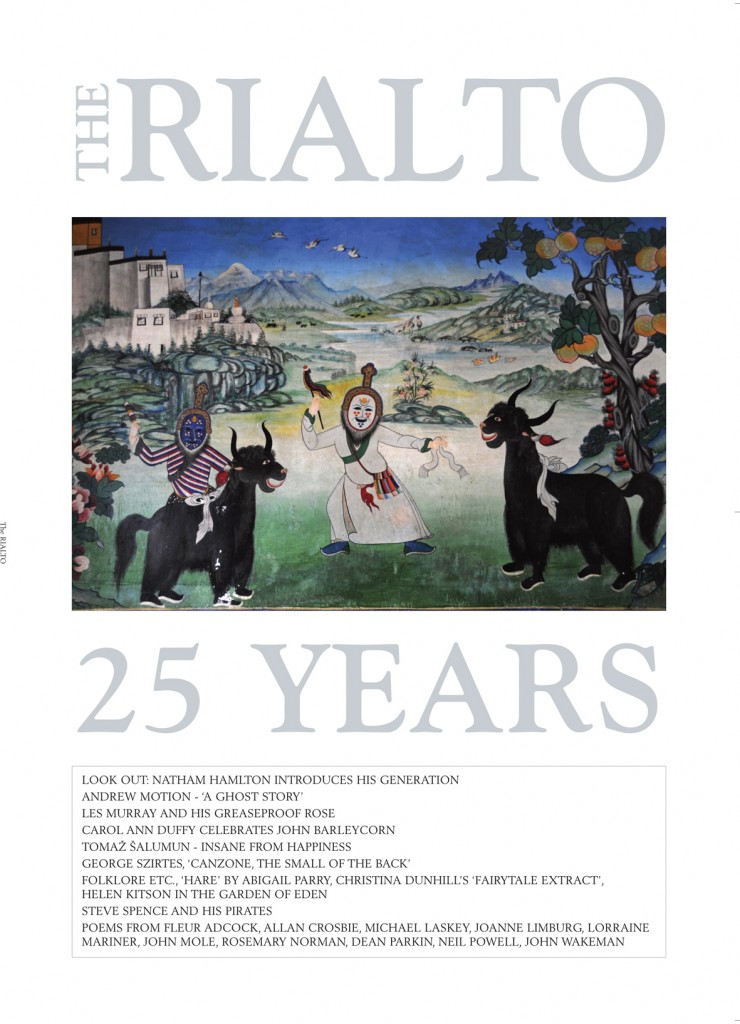
I'd also recommend the latest issue of The Rialto, celebrating 25 years of this major publication's appearances, and including - among new work from Carol Ann Duffy, Andrew Motion, Lorraine Mariner and Rachel Curzon - 'Look Out', the first part of a special feature on new poets under 35 edited by Nathan Hamilton, with poems from Andrew Jamison, Luke Kennard, Chris McCabe, Heather Phillipson, Keston Sutherland and Jack Underwood. Well worth a look.

The latest issue of Orbis, #150, is also packed with poems and reviews of recent books, and its usual 'Lines on Lines' section of candid reader comments on the previous issue. Where the poems in #150 are concerned, highlights for me came in the shape of Rupert Loydell's 'Paper Children', Eoghan Walls's 'Terminal One', and Todd Swift's 'The Port Daniel House'. Reviews include a round-up of recent pamphlets from the indefatigable Smith/Doorstop (the publishing house of the, now Sheffield-based, Poetry Business), including Sally Goldsmith's Singer, a short little book that packs an emotional yet unsentimental punch, and one which I'd recommend getting hold of.

Lastly, the latest issue of the Times Literary Supplement (No 5590, May 21 2010) contains the usual array of incisive, decisive, highly readable and thought-provoking literary reviews, not least a piece on Merrill Chleier's study of architecture and gender in American film, Skyscraper Cinema, and Michael Hofmann's translation of Gottfried Benn's poem, 'Englisches Café'. But I'd like to point you in particular towards the poetry reviews, not only because of pieces on new collections from Selima Hill and Antony Dunn, among others, but because there's a review of my own included of Sian Hughes's excellent debut, The Missing. It's a real shame that this book didn't come away with a prize or two, having been shortlisted for the Forward Prize for Best First Collection and chosen as a Poetry Book Society Recommendation. As I say in the review, the collection is a short one of, often, short poems: something that perhaps belies its exactitude, hard-won emotional truths, and long road to completion. At any rate, it really is a great debut collection, and one which I've returned to on several occasions recently. So I'll end by saying that, as well as subscribing to a poetry magazine today, you should really push the boat out and go and order The Missing, which you can pick up from Salt's website, here. And if you need any more convincing, you should first read this powerful and emotive elegy, 'The Send-Off', which won Hughes the Arvon International Poetry Competition a few years back. Moving isn't the word.
More about → Recent Issues

Robin Vaughan-Williams: The Manager

Posted by Expert Gadget Reviewer on Tuesday, 27 April 2010


Managers, offices, the daily grind, rows of computer screens, crap coffee machines ... a fair number of contemporary poets have been swift to pen their thoughts on the typical working conditions of modern life, but a new pamphlet I recently received, The Manager, is, I think, a novel and original take on the 9-5 world that most of us inhabit. As its title suggests, it centres on the shifting persona of "the manager", in a sequence that moves from the serious to the irreverant and from the depressing to the uplifting with surprising ease. A few excerpts to pique your interest:

The manager has proverbs on the wall about being a good man
and he reads them at times of intense isolation

when his office has become a cell
and the laughter in the next room is a barrier

he has not the skill to clear.
(Manager #1: Mantra)

The manager burns, he burns
with the heat of an example
others will follow: a new kind of leader.
(Manager #5: Health & Safety Incident)

The manager's eyes are not his own.
He has seen more than one man can bear.
He has seen the high street of humanity,
the bargain hunters, shop lifters,
just looking, and disfigured returns -
receipt or no receipt, that's policy.
(Manager #8: The Manager's Eyes)

Doesn't he realise how vulnerable I am?
I'm a sensitive person.
'I'm a poet,' I say.
'You can't fire me,
I'll put you in a poem.'

'Not a very well known poet,' he says
and fires me anyway.
(Manager #10: Fired!)


Thought-provoking and entertaining, it's a pamphlet that's consistently effective and insightful but at the same time understated, and which doesn't take itself too seriously. Well worth getting a copy, available from HappenStance press at £4, which isn't much more than that extra pint down the pub on a Friday.
More about → Robin Vaughan-Williams: The Manager

Iota

Posted by Expert Gadget Reviewer on Tuesday, 30 March 2010


News just in: the shortlist for the Iota International Poetry Competition 2010 has just been announced, judged this year by the talented - and typically stylishly turned-out - poet Tim Turnbull. And amongst some familiar names - Martyn Crucefix, Mick Wood, Matthew Caley and Christopher North - I'm chuffed to see a poem of my own shortlisted.

The full list of prizes, shortlisted poets and poems is below; the winners will be announced at an awards event at the University of Gloucestershire on April 19th.


1st Prize £2,000
2nd Prize £1,000
3rd Prize £500
10 Supplementary Prizes of £50


(in no particular order)


"Here is The News" by Carol Beadle

"A truck called 'Perseverence' ", by Martyn Crucefix

"Look Who's Shunting The Nuclear Train", by Mick Wood

"Playtime", by Maeve Henry

"Los Angeles", by Matthew Caley

"The embolism suffered by Edward's father (during a sudden cold
snap)", by Rosie Sheppard

"Doors", by Kevin Russell-Pavier

"In the Gardens of Titans", by Clint Frakes

"Everyone Matters", by Jamie Walsh

"Untitled", by Pat Cash

"Where the Bull Got In", by Kate Miller

"New Flat", by Ben Wilkinson

"Eurythmy Artiste with Toque", by Christopher North


[ends]
More about → Iota

To The Lighthouse

Posted by Expert Gadget Reviewer on Monday, 29 March 2010


For those interested, my review of the last four poets to produce pamphlets as part of Tall-Lighthouse's Pilot series (published 18 younger poets over the course of three years) is up now at Stride magazine. Charlotte Runcie, Richard O'Brien, Ailbhe Darcy and Simon Pomery - all very different writers, and all names to look out for in the future, not only when their first full collections appear, but when the annual Society of Authors' Eric Gregory Awards are announced in the coming years, no doubt.
More about → To The Lighthouse

The Lengthening Winter

Posted by Expert Gadget Reviewer on Thursday, 4 February 2010

Happy to leave work today and find not only that the bastard ice has melted (thus rendering my hilly walk home a pleasurable one in which I can let my thoughts wander, as opposed to this morning, when I shuffled like some early-to-rise madman with my eyes glued to the treacherous pavements, only occasionally lifting my head to watch the bloke in front march then wobble then flail with desperation), but also, on arrival home, to find that this week's TLS had fallen onto my doormat, and includes two of my poetry reviews, on Carrie Etter's The Tethers, and Lorraine Mariner's Furniture. The issue (no. 5575; February 5 2010) also contains, among other things, two new poems from Simon Armitage, which like all of the recent poems of his which I've spotted here and there (Rialto, Poetry London, and in the excellent online poetry journal Blackbox Manifold), seem to be something of a departure from his characteristic style. Worth checking out.
More about → The Lengthening Winter

Jen Hadfield and Greta Stoddart

Posted by Expert Gadget Reviewer on Tuesday, 26 January 2010


A quick pointer to those interested - on the Contemporary Writers site, you can now find critical perspectives on the poetry of two very different, but equally fascinating, writers: Jen Hadfield and Greta Stoddart. Hadfield's second collection, pictured above, won the T.S. Eliot Prize in 2008; recently awarded to Philip Gross in 2009 for his collection The Water Table.

And to those on/off regular readers of this blog: apologies for the hopeless lack of posts of late. Life, as the man says, has a habit of getting in the way. Work and writing permitting, I should hopefully find time to make some more substantial posts in the not-too-distant future. Cheers for sticking around.
More about → Jen Hadfield and Greta Stoddart

Poetry Books of 2009: Etter, Lumsden, Paterson, Read, Williams & Mackenzie

Posted by Expert Gadget Reviewer on Tuesday, 8 December 2009

Like many other poetry readers and writers, I was recently invited to submit my three favourite poetry collections of 2009 to Michelle McGrane's feature on her Peony Moon site (if you missed it, the first of eight installments is here). And like other readers and writers who also happen to blog from time to time, I thought I'd elaborate a little on these choices, while also offering a few other collections which would have been included on a longer list (of six, to be exact).

Carrie Etter's The Tethers was perhaps the easiest choice - I can't say too much about it as I'm reviewing the book elsewhere, but its poems are so elegant, precise, witty and intense it made for a reading experience unlike any other I've had this year. Full of allusion and yet entirely contemporary, by turns darkly serious and unusually funny - it's lyrical invention, range and ambition make obvious the collection was years in the making. Take the wonderful close to 'The Daughters of Prospero':
Placing white boat after boat onto a brook,

because she has learned beginner's origami,
because her fingers have amassed a score of cuts,

because some of the boats never looked seaworthy,
because a surprising number can glide like swans,

the girl sets her boats on a fatal course, and though
her head is bent, I can just see her eyes' fierce gleam.

I also chose Roddy Lumsden's Third Wish Wasted; somewhat of a departure from his earlier work, though the development evident in this book was hinted at in his previous collection, The Drowned Man, published in his New & Selected Poems. Its formal invention, wry humour and leaping from dazzling image to image are refreshingly energetic if sometimes dizzying, and the best poems - 'Against Complaint', 'Keepsakes', 'Stone Tape Theory' and 'The Beautiful' - are the business. Here are the final pitch-perfect lines of the latter:
                                              They
drift unapproached, gazed never-selves,
blunt paragons of genetic industry. We

desire them but cannot want such order.
We stand, mouths open, and cannot help
stammering our secrets, nailed to water.

The other collection I picked was Don Paterson's Rain. A predictable choice, some might say, but give me a chance to explain first. I'm not so much a fan of the book as a whole - I think in terms of consistency it can't quite compete with God's Gift to Women, or even Landing Light - as I am for its containing what I think are some truly remarkable individual poems, borne of Paterson's Frostian lyric gift, melancholic humour and brilliant turn of phrase. 'Two Trees', for instance, is an elegant yet unadorned poem which slyly, almost frustratingly, undercuts its cumulative beauty in its terse final lines, while the sprawling 'Song for Natalie 'Tusja' Beridze' is a liberated celebration of music and the internet, reflecting all of our geeky obsessions. I don't think it's too bold a thing to say that both will probably be remembered among the major poems written at the start of this century. For my money though, the title poem is still by far the best in the book, though I'm a sucker for this kind of soaring lyric poetry:
I love all films that start with rain:
rain, braiding a windowpane
or darkening a hung-out dress
or streaming down her upturned face;

one big thundering downpour
right through the empty script and score
before the act, before the blame,
before the lens pulls through the frame [...]

But while I'd recommend all three of these titles, there are a handful of others I'd also like to point towards. First is Sally Read's Broken Sleep, her second book since her impressive Bloodaxe debut, The Point of Splitting. I've only recently got stuck into this collection having bought it some months ago, but as with her debut, I've enjoyed what I've read given her ability to marry a gentle, closely observant lyric style with often difficult, even painful, subject matters. In the main sequence of poems which address pregnancy, birth and motherhood in often surprising ways, the title poem is particularly memorable; partly in dialogue with Plath's 'Morning Song':
The birds rise together as though

on an up-draught. I spread
your outstretched fingers
on the back of my hand as you
work away at one breast -

ears pulling in time, toes curling;
your whole body drinking -
and lost milk from my other breast
grows cold as rain on my nightdress.

Another book worth buying is Tony Williams' debut, The Corner of Arundel Lane and Charles Street. As the title suggests, Tony is a Sheffield-based poet, and it was grand to read at his collection's launch, having followed his poems' appearances in mags and journals over the years. There are plenty of reasons to read Williams' poems. First, his influences are as much European (and specifically German Romantic) as they are British, which makes his best work highly distinctive. His poems are also funny, and witty, though as W.N.Herbert notes in his endorsement, '[Williams] understands that wit, as much as it may delight the reader, is always melancholy'. 'The Matlock Elegies' perhaps best captures Williams' ability to combine insightful profundity, ennui and wicked humour to great effect:
O my beloved Matlock! Market town
with barely a market to speak of,
my county town, my botched Eden.
Old Matlock, Matlock Green, Matlock Bank,
loop of the hated supermarket road,
the old quarry where the valley's
truculent aggression pools as sediment,
the satellites of Tansley and Elton, Winster,
Lea and Holloway. Matlock Bath,
tawdry jewel, I curse you as a tourist honey-pot;
you shadow me even unto Death. You slink
like a line of warts through the gorgeous
rock of my deliverance. A part of me
wanders forever round your amusement arcades
in an off-white polyester shirt smelling of stale teenage sweat
and a blue school tie. Another is sick in the woods.

Last, but not least, I'll recommend Rob A Mackenzie's debut, The Opposite of Cabbage, a collection I reviewed for Magma 44, where I described his writing as 'switching between playful contemporary wit and dark humour, honest feeling and compassion, and an occasional, beguiling obscurantism driven by language's slipperiness and a distrust of simple explanations'. Bernadine Evaristo sums the collection up nicely by describing Mackenzie's poetry as 'kaleidoscopic' - varied, often unusual, frequently shifting register and changing tack, it's a mixed yet surprisingly consistent book of poems. But my favourite piece is still 'In the Last Few Seconds', which vividly paints the cinematics of a car crash:
You expect a a flashback, a potted bio
of divorce and automobile replacement -
how one breakage led to another - film noir
    bleaching the blackness,

but instead stars blister across the sunroof.
Cracks appear. You wait for the tunnel sponged in
light from some new world. But the car splits water,
    floats in its shadow.

All books worth getting hold of, then, and that's before I start on those poetry volumes which aren't single collections, including Michael Donaghy's essential Collected Poems, and the Byrne and Pollard edited Bloodaxe anthology of younger poets, Voice Recognition. Also difficult to believe that certain collections were published over a year ago, like Mark Waldron's excellent debut...

----------

In other "news", it's also just over a year since my first pamphlet of poems, The Sparks, was published by tall-lighthouse press - eleventh in their Pilot series, showcasing emerging British and Irish poets under 30.

As expected, it didn't exactly receive a raft of reviews, but then pamphlets never tend to get much coverage, and I've been fortunate enough to receive kind comments on it from various poets and readers, which has been encouraging.

Since publication it's also sold steadily, at readings and other events, and at the Sheffield Hallam University branch of Blackwell's, who took a chance on ordering it in, and have stocked in another handful each time it's sold out, for which I'm really grateful.

Thanks to this kind support, it won't be long before the first modest print run has sold - something which makes me personally chuffed, but mainly thankful that people have bought it alongside other tall-lighthouse titles, and so supported an excellent small press - home to up-and-coming writers including Adam O'Riordan, Emily Berry, Helen Mort, Aoife Mannix, and many more besides.

For those interested in getting hold of a copy of The Sparks who haven't yet, there are still a few copies available at the Blackwell's mentioned above, and you can also find it on the tall-lighthouse website, here. I'm not going to lie to you and say they'd make perfect Xmas gifts (there're no mentions of reindeer, tinsel, or turkey dinners contained within its pages, and snow only appears as a bit of wishful thinking), but I'd appreciate the support nonetheless.

I'm also reading a poem from the pamphlet on Asking a Shadow to Dance, a forthcoming DVD from Oxfam, along with readings from Daljit Nagra, Kayo Chingonyi, Lorraine Mariner and Heather Phillipson, among others - more on which in the near future.
More about → Poetry Books of 2009: Etter, Lumsden, Paterson, Read, Williams & Mackenzie

Verse Palace

Posted by Expert Gadget Reviewer on Tuesday, 3 November 2009

The questions and discussions surrounding why and how writers write can be as fascinating and thought-provoking as good writing itself, no? And this is particularly true of poetry, with all of its nuanced complexity and intoxicating musicality (but then I would say that, wouldn't I). Well the good news is that - my witterings aside for a moment - an excellent new online project has recently been launched, intended to offer a platform for poets to talk about an aspect of writing or reading poems which currently interests them.

It's called Verse Palace, and will feature a post a week solicited from poets, teachers and poetry readers of all opinions, interests and tastes. Some of the contributors already lined-up include David Wheatley, Vidyan Ravinthiran, Mary Jo Bang and Michael Hofmann. Well worth visiting the site over the coming months as it develops then, and getting involved in the discussions.

First up is Poetry Review editor Fiona Sampson, with her thoughts on translation and free verse. Do check it out.
More about → Verse Palace

Horizon Review

Posted by Expert Gadget Reviewer on Monday, 12 October 2009

So the third issue of Salt Publishing's online literary journal, Horizon Review, has just been published. Edited by Jane Holland, it's a fascinating, varied, sometimes even satisfyingly infuriating read, and builds on the strengths of its previous issues, proving it can easily compete with the best of the printed mags.

Issue 3 includes new poems by David Morley, Helen Ivory, Barbara Smith, Claire Crowther and Sam Riviere; reviews of many recent collections including Hugo Williams' West End Final, Carrie Etter's The Tethers, and a particularly excellent review of Don Paterson's Rain by John McCullough; and a series of interviews, the most interesting, contentious and quotable of these being Vidyan Ravinthiran in conversation with Craig Raine. In fact, I might well post a separate discussion of some of the stuff which Raine has to say here, finding as I did some bits eminently sensible, some disagreeably caustic, and some just downright antagonistic (not entirely a bad thing). I should also add that what he has to say is on occasion pretty funny, often illuminating, and... hell, just go and read it and I'll stop blathering on.

Also, for those interested (jumping from Don Paterson's aforementioned Forward Prize-winning Rain to Emma Jones's Best First Collection-winning The Striped World) in this week's issue of the Times Literary Supplement (October 16, No 5559) my reviews of both Jones's book and fellow Australian poet Kevin Hart's Young Rain will appear. Do check them out if you can.
More about → Horizon Review