Showing posts with label TLS. Show all posts

Review: Lorraine Mariner's Furniture

Posted by Expert Gadget Reviewer on Tuesday, 19 April 2011


The title poem of Lorraine Mariner’s debut volume tells the story of two young women in their twenties: one who has “acquired” a family, home and furniture, the other “who’d only ever known the fully-furnished, / the three white goods”. As both a metaphor for unrealised, misplaced aspirations and an emblem of modern life’s clutter, furniture in the broadest sense is ubiquitous in Mariner’s poems. Many specifically address such objects, intent on uncovering the social significance they embody, as in the complex staff-room politics of “Chair”, or the collapsed Ikea wardrobe of “There is nothing wrong with my sister”. Elsewhere, the cultural detritus of Littlewoods catalogues, CDs, predictive texts and London Lite newspapers grows irritatingly to litter the book with their almost programmatic contemporaneity, though frustration is usually offset by Mariner’s natural, charming and engagingly chatty free verse.

The best poems in Furniture tend to be the longest, affording Mariner room to unpick everyday subject matters in often surreal narratives. In its study of human infidelity, “Feathers” sustains an impressive (if unlikely) extended metaphor based on birding, while “My beast” brings children’s fairytale and adult reality into literal collision, the poet imagining her father’s “Volvo reversing into a beast’s carriage” while she “end[s] up at the castle as compensation”. “Assertiveness role play” treads a similar line between contemplative seriousness and wry comedy. “Thursday” is an accomplished and original perspective on terrorism, detailing in lengthy stream of consciousness the poet’s journey to work on the morning of the 2005 London bombings.

It is in the short, first-person lyrics which dominate the collection that the shortcomings of Mariner’s verse appear. Too many of her poems fail to develop their slight subject matters: in “Shop names”, a brief discussion of retail puns yields nothing beyond mild amusement; “My wedding” sacrifices a more provocative engagement with the personal implications of our digital era to throwaway, crowd-pleasing effects. At its best, Mariner’s work is sure-footed, energetic, and often strikes an original tone; at worst, it exhibits prosiness and chick-lit triviality. But the strongest poems – foremost among them the fully realised character study of “In my worst moments” – successfully combine a witty light touch with intelligent reflection.


first published in the Times Literary Supplement
More about → Review: Lorraine Mariner's Furniture

Review: Mark Waldron's The Brand New Dark

Posted by Expert Gadget Reviewer on Tuesday, 1 March 2011


The late American comic Bill Hicks once infamously began a stand-up routine with the deadpan line “If you work in advertising or marketing, kill yourself now”. He may well have made an exception for someone like Mark Waldron, a poet who writes adverts for a living. His debut, The Brand New Dark, is far removed from the clichés and superficiality of modern commercialism; witty, subversive, often darkly comic poems which are full of unusual images and curious turns of phrase. But the world which Waldron deftly unpicks is also a bleakly decadent and harrowingly pertinent one, uncovering “The King … in his counting house / not counting out his money, but making some swanky / kind of love to his secretary”, while elsewhere, a man dressed in a Mickey Mouse suit at Disneyland becomes a chilling metaphor for our increasingly isolated and virtual lives.

The success of the book, however, stems from the way in which Waldron handles the sinister, noirish aspects of contemporary life; a darkness which frequently rears its head in the commercial branding satirized in the volume’s title. One might expect a fug of depression or moralizing to pervade poems on mass production, sex as commodity, and the drawbacks of technological advancement. But Waldron’s gift is to approach these subjects from novel, oblique angles, often with a tone that is more implicating than accusatory. And so in “The Sausage Factory”, the meat is figured as “wee circus elephants, / gripping the tail of the one that goes before, / marching uncertainly away from death”, while in a series of dramatized poems focusing on a fictionalised, attractive young woman, the narrator is candid about his sexualizing of her: “Oh Marcie, I’ve watched you come half to yourself, // … and, / Oh, say it! watched your body, / a scented buddy to yourself, your self’s pork dolly, / dreaming its own fuckable dream”.

Overall, there is much to admire about The Brand New Dark: only a few squib-like failures occur where the humour misfires, dotted about an otherwise wide selection of engaged and engaging poems addressing modern life in all of its complexity; like the manatees that close the book, “arranging and rearranging themselves / into what we might call stories”. It confirms Mark Waldron as an emerging talent to watch.


first published in the Times Literary Supplement
More about → Review: Mark Waldron's The Brand New Dark

Review: Simon Armitage's Seeing Stars

Posted by Expert Gadget Reviewer on Saturday, 12 February 2011


Simon Armitage’s latest collection, Seeing Stars, is a curious departure from his previous work. The hallmark of his poetry to date – a combination of coined phrases, warped cliché and heady vernacular with an energising adherence to meter, rhyme and traditional forms – has not exactly disappeared, but has certainly dissipated. This new book is full of disorienting, freewheeling narratives that, despite giving the fleeting impression of verse in their arbitrary alignment, are more like prose imbued with poetic intensity; flash fiction of a sort. Of course, if Armitage wants to call these poems, then they’re poems. What matters is whether they succeed as such.

Seeing Stars opens with “The Christening”, a dramatic monologue in the voice of a sperm whale. Through a mixture of assured description and humour, it has its thought-provoking moments: “My song, available on audiocassette and / compact disc is a comfort to divorcees, astrologists and / those who have ‘pitched the quavering canvas tent of their / thoughts on the rim of the dark crater’.” But the digressions that drive the poem brim with ideas that feel unfocused and underdeveloped. As a feature of Armitage’s live performances, it is sure to have audiences entertained, but its throwaway inconsequentiality offers little worth revisiting on the page.

Other poems falter on similar grounds. Another capricious monologue, “The Last Panda”, features a creature that is part endangered species, part former Beatle Ringo Starr – a clever conceit, but one that again prompts a discursive collection of pseudo-philosophical thoughts. “Hop In, Dennis” tells the tall tale of the former Arsenal striker Dennis Bergkamp hitching a lift; “one of dozens of Dennises”, the poem’s narrator recounts, “to have found their way / into the passenger seat of my mid-range saloon.” Amusing though it is, this revelation fails to lend the poem much depth or purpose, and neither do its abruptly portentous last lines.

The poem suffers further in calling to mind “Hitcher”: a precise, rhythmically off-kilter piece that Armitage’s admirers will remember from his third collection, Book of Matches. That poem conjures a contemporary sense of despair in its clipped depiction of coolheaded violence; by comparison, “Hop In, Dennis” is casual, chatty and colourful, but lacks real intent, its flashes of brilliance stemming from Armitage’s inventive use of simile and metaphor. No other poet, after all, could describe a footballer changing in the backseat of a four-seater and make a success of it: “a contortion of red and white, like Santa Claus in a badger / trap.”

Seeing Stars is studded with these original, dazzling images. In “Collaborators”, a barber views a client’s bald head as “a mirrorball set / with a hundred glistening beads of sweat”; in “The Cuckoo”, a young man who discovers his family and friends are government agents, without a care for him, “felt like a gold tooth sent flying through the air in a fist fight”. But this imaginative flair fails to prevent many of the poems from feeling circuitous and overwritten. Those which do stand out are the shorter, less showy pieces: “The English Astronaut” is a superbly sardonic commentary on the national character; “Last Day on Planet Earth” provides a series of vivid snapshots from a nightmarish future.

Despite its shortcomings, however, Seeing Stars does feel like a necessary work. As James Lasdun remarked when reviewing a fifth book of poems, Cloudcuckooland, in the TLS: “Armitage seems to have emerged more or less fully formed with his first collection, Zoom” (November 7, 1997). Since then, he has spent two decades exploring and refining a wonderfully distinctive poetic voice – exhaustive, if not exhausting work. While the carefree excess and absurdism of Seeing Stars may not altogether come off, it does see Armitage letting off steam, and points towards a new phase.


first published in the Times Literary Supplement
More about → Review: Simon Armitage's Seeing Stars

Seeing Stars

Posted by Expert Gadget Reviewer on Wednesday, 3 November 2010


Alongside a slightly lengthier piece on John Fuller's latest collection, Pebble and I, by William Wootten, the current week's TLS (29 October) contains my review of Simon Armitage's latest book, the PBS Choice (and so automatically T.S. Eliot prize-shortlisted) Seeing Stars. A new direction for his work, sure, but is it actually any good?
More about → Seeing Stars

Recent Issues

Posted by Expert Gadget Reviewer on Tuesday, 25 May 2010

Well, here are a few recent issues of magazines that I thought I'd flag up, and no, not just because I've something of my own included in them, which in several cases I don't, but because I've subscriptions to many poetry mags and journals for the simple reason that, in many ways, they're the lifeblood and engine rooms of new writing and, on this slightly gloomy looking Wednesday morning, I'd like to encourage you, dear Wasteland reader, to consider subscribing to a new publication today.

First off, the latest issue of New Welsh Review dropped with a satisfying thud through my letterbox the other week, and aside being excellently produced (nothing superficial about enjoying the look and feel of a stylish book or magazine with high production values, and to be honest, NWR holds its own against most books, never mind journals), it also contains plenty of engaging new writing, including two new poems from Samantha Wynne-Rhydderch, fiction from Nii Ayikwei Parkes, plus reviews of Philip Gross's T.S. Eliot prize-winning collection The Water Table, and a new collection of short stories inspired by the work of Jane Austen.

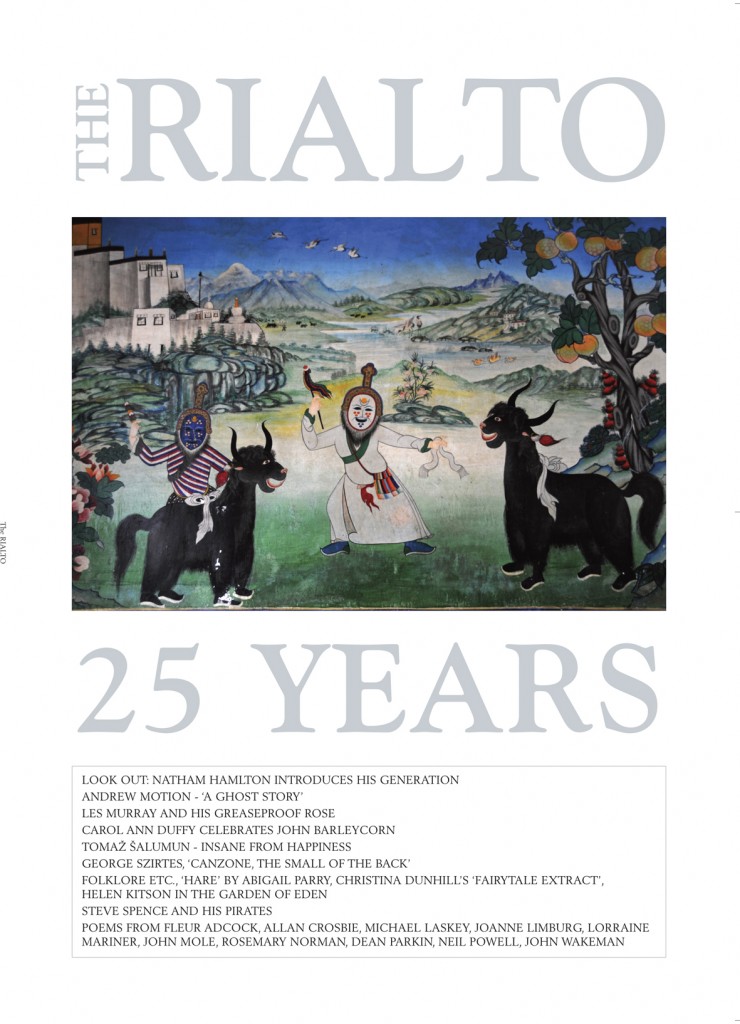
I'd also recommend the latest issue of The Rialto, celebrating 25 years of this major publication's appearances, and including - among new work from Carol Ann Duffy, Andrew Motion, Lorraine Mariner and Rachel Curzon - 'Look Out', the first part of a special feature on new poets under 35 edited by Nathan Hamilton, with poems from Andrew Jamison, Luke Kennard, Chris McCabe, Heather Phillipson, Keston Sutherland and Jack Underwood. Well worth a look.

The latest issue of Orbis, #150, is also packed with poems and reviews of recent books, and its usual 'Lines on Lines' section of candid reader comments on the previous issue. Where the poems in #150 are concerned, highlights for me came in the shape of Rupert Loydell's 'Paper Children', Eoghan Walls's 'Terminal One', and Todd Swift's 'The Port Daniel House'. Reviews include a round-up of recent pamphlets from the indefatigable Smith/Doorstop (the publishing house of the, now Sheffield-based, Poetry Business), including Sally Goldsmith's Singer, a short little book that packs an emotional yet unsentimental punch, and one which I'd recommend getting hold of.

Lastly, the latest issue of the Times Literary Supplement (No 5590, May 21 2010) contains the usual array of incisive, decisive, highly readable and thought-provoking literary reviews, not least a piece on Merrill Chleier's study of architecture and gender in American film, Skyscraper Cinema, and Michael Hofmann's translation of Gottfried Benn's poem, 'Englisches Café'. But I'd like to point you in particular towards the poetry reviews, not only because of pieces on new collections from Selima Hill and Antony Dunn, among others, but because there's a review of my own included of Sian Hughes's excellent debut, The Missing. It's a real shame that this book didn't come away with a prize or two, having been shortlisted for the Forward Prize for Best First Collection and chosen as a Poetry Book Society Recommendation. As I say in the review, the collection is a short one of, often, short poems: something that perhaps belies its exactitude, hard-won emotional truths, and long road to completion. At any rate, it really is a great debut collection, and one which I've returned to on several occasions recently. So I'll end by saying that, as well as subscribing to a poetry magazine today, you should really push the boat out and go and order The Missing, which you can pick up from Salt's website, here. And if you need any more convincing, you should first read this powerful and emotive elegy, 'The Send-Off', which won Hughes the Arvon International Poetry Competition a few years back. Moving isn't the word.
More about → Recent Issues

The Lengthening Winter

Posted by Expert Gadget Reviewer on Thursday, 4 February 2010

Happy to leave work today and find not only that the bastard ice has melted (thus rendering my hilly walk home a pleasurable one in which I can let my thoughts wander, as opposed to this morning, when I shuffled like some early-to-rise madman with my eyes glued to the treacherous pavements, only occasionally lifting my head to watch the bloke in front march then wobble then flail with desperation), but also, on arrival home, to find that this week's TLS had fallen onto my doormat, and includes two of my poetry reviews, on Carrie Etter's The Tethers, and Lorraine Mariner's Furniture. The issue (no. 5575; February 5 2010) also contains, among other things, two new poems from Simon Armitage, which like all of the recent poems of his which I've spotted here and there (Rialto, Poetry London, and in the excellent online poetry journal Blackbox Manifold), seem to be something of a departure from his characteristic style. Worth checking out.
More about → The Lengthening Winter

Horizon Review

Posted by Expert Gadget Reviewer on Monday, 12 October 2009

So the third issue of Salt Publishing's online literary journal, Horizon Review, has just been published. Edited by Jane Holland, it's a fascinating, varied, sometimes even satisfyingly infuriating read, and builds on the strengths of its previous issues, proving it can easily compete with the best of the printed mags.

Issue 3 includes new poems by David Morley, Helen Ivory, Barbara Smith, Claire Crowther and Sam Riviere; reviews of many recent collections including Hugo Williams' West End Final, Carrie Etter's The Tethers, and a particularly excellent review of Don Paterson's Rain by John McCullough; and a series of interviews, the most interesting, contentious and quotable of these being Vidyan Ravinthiran in conversation with Craig Raine. In fact, I might well post a separate discussion of some of the stuff which Raine has to say here, finding as I did some bits eminently sensible, some disagreeably caustic, and some just downright antagonistic (not entirely a bad thing). I should also add that what he has to say is on occasion pretty funny, often illuminating, and... hell, just go and read it and I'll stop blathering on.

Also, for those interested (jumping from Don Paterson's aforementioned Forward Prize-winning Rain to Emma Jones's Best First Collection-winning The Striped World) in this week's issue of the Times Literary Supplement (October 16, No 5559) my reviews of both Jones's book and fellow Australian poet Kevin Hart's Young Rain will appear. Do check them out if you can.
More about → Horizon Review

The Mole

Posted by Expert Gadget Reviewer on Wednesday, 15 July 2009

Over at her blog, should you fancy a look, Carrie Etter has kindly featured a poem from The Sparks, as part of a (very) brief tour of blogs I thought I'd do to promote the pamphlet.

The poem is 'The Mole' (hence the photo above), and was first published in the Times Literary Supplement early last year.
More about → The Mole

Reviews: Jacob Polley & Colette Bryce

Posted by Expert Gadget Reviewer on Saturday, 6 June 2009


For those interested, my review of Picador poet Jacob Polley's first novel will appear in this coming week's TLS (June 12 2009).

In the just-published issue of Stand, vol 9 (1), I'm informed that my review of Colette Bryce's third book of poems, Self-Portrait in the Dark, also appears.
More about → Reviews: Jacob Polley & Colette Bryce

Just One Book - Salt Publishing

Posted by Expert Gadget Reviewer on Wednesday, 20 May 2009

As those of you who read other poetry & literary blogs and/or drop into UK poetry forums will know, the enterprising poetry publishers Salt have hit hard times. Partly due to discontinued grants from Arts Council England and the current economic downturn, this is particularly depressing as Salt have always been committed to building a poetry press eventually capable of sustaining itself, something it has worked towards by seeking out and publishing some of the most impressive new poets to emerge in the UK in recent years (Rob A Mackenzie, Julia Bird, Luke Kennard, Mark Waldron and Katy Evans-Bush, to name but a few) as well as more established writers including Jane Holland, Tim Dooley and Tobias Hill. It also has what promise to be strong first collections on the horizon from Abi Curtis, Tom Chivers and Tony Williams.


To help save Salt, then, please consider the following:


JUST ONE BOOK

1. Please buy just one book, right now. We don't mind from where, you can buy it from us or from Amazon, your local shop or megastore, online or offline. If you buy just one book now, you'll help to save Salt. Timing is absolutely everything here. We need cash now to stay afloat. If you love literature, help keep it alive. All it takes is just one book sale. Go to our online store and help us keep going.

2. Share this note on your profile. Tell your friends. If we can spread the word about our cash crisis, we can hopefully find more sales and save our literary publishing. Remember it's just one book, that's all it takes to save us. Please do it now.

With my best wishes to everyone
Chris
Director
Salt Publishing
http://www.saltpublishing.com


It would be a great loss to UK poetry if Salt were to fold. I've just ordered a copy of Tim Dooley's Keeping Time, and would urge anyone who reads and values contemporary poetry to buy a title or two from their list - I'd recommend Rob A Mackenzie's The Opposite of Cabbage and Mark Waldron's The Brand New Dark, my reviews of which are forthcoming in Magma and the TLS respectively.
More about → Just One Book - Salt Publishing

Odds and Ends

Posted by Expert Gadget Reviewer on Tuesday, 31 March 2009

Still haven't found time to blog about my time at StAnza, Scotland's international poetry festival held in St Andrews, yet - though I intend to get round to it soon. In short, it was a great (long) weekend: particular highlights including readings from Bill Manhire, New Zealand's foremost contemporary poet; the excellent Simon Armitage; poetry centre stage with Robert Crawford and Kate Clanchy; and the launch of Roddy Lumsden's new collection, Third Wish Wasted. And I enjoyed taking part in the poetry breakfast on young poets, as well as the tall-lighthouse Pilot reading (alongside Abi Curtis, Adam O'Riordan, Jay Bernard and Emily Berry) and pamphlet signing, both of which proved popular.

Before I get to doing a proper write-up then, I thought I'd flag up a few forthcoming odds and ends: I've two new poems that'll appear in the next issue of Poetry Matters on the Tower Poetry site, and a short sequence that'll crop up in a future issue of Stand magazine. Also in the next two issues of Stand, I've a couple of reviews: first of Colette Bryce's Self-Portrait in the Dark; second of Glyn Maxwell's Hide Now. And I've completed a fair number of critical perspectives of poets for the British Council Contemporary Writers site which'll go live in due course, including Robert Crawford, David Constantine, Patrick McGuinness, Carol Rumens, Tom Paulin, and the late Mick Imlah.

Alongside forthcoming reviews for Magma and the TLS and working on new poems, then, I'm having a happily busy time of it - the only problem being that man flu has recently halted me from doing much at all productive; hunched as I am over the PC with a mug of tea and packets of honey and lemon Lockets. Even if you are misguided enough to do so, however, please don't extend your sympathies - many, not least my girlfriend, will amply attest to how utterly pathetic I am when afflicted with only the slightest of sniffles.
More about → Odds and Ends

Poetry Feature: Conor O'Callaghan

Posted by Expert Gadget Reviewer on Sunday, 8 March 2009


Conor O’Callaghan, an Irish writer born in Newry in 1968, is one of those poets who critics may lazily – albeit quite rightly – describe as ‘one of the best of his generation’, though he actually seems to fall on the cusp of two generations. Or at least has fallen short, despite having appeared in seminal Irish anthologies, of major British anthologies and promotions – too young for the New Poetry and the PBS’s New Generation campaign; inexplicably missing from the Next Gen and falling short of the cut-off point of Roddy Lumsden’s forthcoming Identity Parade – as inadequate as these may ultimately be at fully checking the pulse, let alone establishing the hierarchy of the literature of a given period (history will do that), they still (usually quite rightly) cement reputations, develop readerships, and give a representative flavour of poetry at the time. This isn’t to badmouth these publications or promotions, but to note that given the inevitable parameters, some genuinely talented and worthy writers often get sidelined or miss out through nothing more than plain bad luck.

This aside, I hope I’m right in reckoning that O’Callaghan’s work will stand the test of time. I can only reach for the usual platitudes in urging you to hunt down copies of his three collections published by Gallery Press to date – The History of Rain (1993) and Seatown (1999), collected together in Seatown and Earlier Poems (2000); and the excellent Fiction, published in 2005 – showcasing the development of an exciting and original poetic voice sounding itself out in poems that are engaged and engaging, witty, smart and sharp, but above all, driven by an energetic music that is as capable of challenging and amusing as it is of moving the reader.

In his review of Seatown in the Times Literary Supplement, Stephen Knight pointed to James Fenton, Robert Frost and Philip Larkin as pronounced influences in O’Callaghan’s work, and for those who are fans of any of these major voices in post-war poetry, you won’t be disappointed by his poems. But at the same time, quite rightly, Knight states that ‘despite the presence of these pungent voices, O’Callaghan’s poetry is marvellously his own’. This is largely to do with the knowingness of the poems, which amounts to more than the winks, nudges, sarcasm and irony that crop up in much contemporary verse. Instead, particularly in Fiction, O’Callaghan’s poetry combines the suggestive, deliberative and symbolic capabilities of verse with the inventive, imaginative qualities most readily associated with fictional prose, often to startling effect. This includes the likes of ‘Out-takes’, exploring the sounds left behind from a recording session (‘leftovers from a cleaned up / final version’; suggesting our polished, distorted view of ourselves); ‘Reception’, where the poet remembers an event from his childhood which turns out to be a story he was told ‘over a glass of ropey Chianti’; ‘Hello’, a sequence of poems exploring the invention of that phrase for ‘the blower, / since some kind of formula / for an opening exchange / had to be agreed upon / to get the ball rolling’; and the excellent vignette ‘The Narrator’, who ‘during the break in chapter / gets up to stretch beneath a skylight’, a theme returned to in ‘The Present Writer’, who ‘gets a kick / inhabiting the third person, as if talking across himself / or forever clapping his own exit from the wings’.

In short, O’Callaghan stuff is the business and deserves a wide readership. And needless to say, his next collection will be well worth waiting for. In the meantime, though, do check out the three poems of his which appear in this month’s issue of Poetry magazine, and the comic ‘The Modern Pastoral Elegy’ in that magazine’s archive. And rather than my blathering on any further here, I’ll let the poetry speak for itself – below is ‘Coventry’, the sonnet that opens Fiction, first published in the TLS.


Coventry


On a night as clear and warm as tonight,
in 1941, a stray German squadron
with a war to win and a radar on the blink
mistook the quays of neutral Seatown
for the lights of greater Coventry.

On a night as clear and warm as tonight –
when she has gone into an almighty huff
and taken the chat over heaven-knows-what
(or something of nothing with a bit of fluff)
and my lot once again is the box-room futon,
the guest duvet –
                                  I am inclined to think
perhaps the Luftwaffe after all were spot on,
and would give my eye-teeth for butterfly bombs
to fall into this silence I have been sent to.


poem by Conor O’Callaghan
republished with permission of the author
first published in the Times Literary Supplement, 20 October 2000
from Fiction (Gallery Press, 2005)
More about → Poetry Feature: Conor O'Callaghan

Mick Imlah

Posted by Expert Gadget Reviewer on Tuesday, 13 January 2009

Talented poet, journalist and TLS Poetry Editor Mick Imlah has died, aged 52, of motor neurone disease. I never had the privilege of meeting Mick, though I will always be grateful for his publishing a handful of my poems, and later, reviews, the first at a time when I had no real biog note to speak of or much of a publication record. His encouragement helped immeasurably, and I am sure that many, many other poets have received similar help and encouragement from Mick along the way, during his 17 years at the TLS - Carrie Etter and David Wheatley two such writers.

This is a huge loss for the world of poetry, as indeed for the world of journalism and literary criticism. It seems odd that, only last week, I completed a critical perspective of his poetry for the British Council's Contemporary Writers website, and had been in touch over a review I recently finished for the TLS. The perspective of his work has now been duly edited and will appear along with his forthcoming profile on the site - one of many appraisals of his work and life which I expect to appear over the coming months.
More about → Mick Imlah

Moniza Alvi in this week's TLS

Posted by Expert Gadget Reviewer on Thursday, 2 October 2008


Just a snippet of news in that I've another review in the TLS this week, following on from last week's 'In Brief' piece on Stephanie Norgate's Hidden River; this week's a more substantial review, covering both Moniza Alvi's Split World, Poems 1990-2005, and her latest PBS Choice collection, Europa. Do check it out if you can.
More about → Moniza Alvi in this week's TLS

By Way Of An Update

Posted by Expert Gadget Reviewer on Saturday, 27 September 2008

Adding to the woeful pattern that's been developing around here this is just a short post and mini-update, so for those of you who do stick around the Wasteland, my thanks and also apologies; I promise I'll post something meatier in the future.

Last weekend I went down to London, and had a very useful (and entirely painless*) editorial meeting with Roddy Lumsden, going through the poems that'll be included in my forthcoming tall-lighthouse pamphlet, The Sparks, to be published alongside Emily Berry's with a launch on November 14th - details on the TL website. I'm feeling slightly more confident about the whole thing, as the meet helped to re-shape certain poems into what - after rewriting - will hopefully be tighter, stronger pieces, and tidy up weaknesses in others that are closer to completion. It was also great to see Roddy perform his own work at the Betsey Trotwood in the evening, and meet other tall-lighthouse Pilot poets who also gave good readings, Retta Bowen in particular. For those interested, my reading 'set list' was as follows:

1. Sunday
2. Byroads
3. The Tesla Coil
4. Filter
5. Lights Out
6. Reflections
7. Hex

It was good to catch up with old friends in the capital, too, not least a school pal who happened to be down for the day before he travels to the States for a few months, who I met by total coincidence on the tube. Unfortunately however, this weekend promises to be less enjoyable, as I've an increasing pile of editing, writing and menial tasks on my to-do-list. Still, I'm enjoying getting properly stuck into Leontia Flynn and Zoe Skoulding's work for critical perspectives I'm writing of them, so it's not all bad...

In the meantime then, before I get around to writing something substantial here, I'll mention that my critical perspective of Faber poet Hugo Williams is now up, and my review of Stephanie Norgate's Forward Prize-shortlisted first collection, Hidden River, is in this week's TLS. Now I'm off to shop for socks and a new pair of trousers. At least it's sunny out...


*Which is to say no poems, or poets, were harmed in the process.
More about → By Way Of An Update

Hell in Contemporary Literature

Posted by Expert Gadget Reviewer on Thursday, 14 August 2008


J.C., who writes the N.B. column on the back page of the TLS, is renowned for his wicked, witty and acerbic sense of humour. So it was with some suspicion that, in reading through back issues of the supplement recently, I approached his coverage of 'the Nicholas Mosley Award for the most inadvisable book title of 2007-08'. Sure enough, Googling its title only brings up another blogger's speculation as to the award's existence, which looks almost certainly to be one of J.C.'s inventions. What's best about the whole thing, however, is the seemingly unlikely titles of the award's shortlisted contenders, including Foreskin's Lament: A memoir by Shalom Auslander, Shut Up He Explained by John Metcalf, and Random Deaths and Custard by Catrin Dafydd, with previous winners including How To Shit in the Woods by Kathleen Meyer and Pox Americana by Elizabeth Fenn.

Too ridiculous to believe? Well, though the award may not, all of these books do actually exist. No, seriously. Go and check for yourself. Foreskin's Lament is a real - and assumedly quite gritty - memoir, recounting a boy's upbringing in an 'ultra-Orthodox Jewish community in New York' and, in adult life, his deliberating as to whether or not he should have his son circumcised. Random Deaths and Custard, on the other hand, is a much more lighthearted affair: a novel that centres around a young woman who lives in Wales, works for a custard factory which is, you guessed it, imaginatively called Custard's, and whom everyone thinks is a lesbian. Oh yes. You can't make this stuff up. Although, at least in the latter case, apparently you can.

For me though, the icing on the thoroughly bizarre cake was J.C.'s mention of a little textbook called Hell in Contemporary Literature, an entry that, along with Steve Penfold's The Donut: A Canadian History, was unfortunately 'considered by the judges but fell at the last hurdle'. As it goes, Hell in Contemporary Literature, a book which 'addresses the subject of 'Hell' as a trope problematically deployed in contemporary reportage of terrorism and acts of war', is in fact by a former university lecturer of mine, Rachel Falconer. Whilst an undoubtedly interesting textbook, then, it just goes to show that becoming enveloped in any writerly project to the detriment of obtaining good critical distance can often produce, if nothing else, some hilarious results.
More about → Hell in Contemporary Literature

The TLS

Posted by Expert Gadget Reviewer on Thursday, 24 April 2008

Alongside reviews of Matthew Francis's new Faber collection, Mandeville, Dennis O'Driscoll's Reality Check, and what looks to be an interesting feature in the Commentary section on Movement poet Thom Gunn, I've just checked the TLS website to find that my poem 'The Mole' is published in this week's issue (25th April).

This is my second poem in the TLS - and hopefully not the last - after a short sequence on the scientist Nikola Telsa appeared back in February 07. Do pick up a copy if you get chance.

In other news, I should also be reviewing an interesting new pamphlet collection soon - Flood, by a young poet called Paul Abbott. It's published by Clutag Press, an Oxford-based publisher who specialise in high quality pamphlets (having recently published work by Mick Imlah, Tom Paulin and Seamus Heaney), and is promisingly described as "a Waste Land for the twenty-first century".

Which reminds me - for those who are interested, the Tower Poetry competition winners for 2008 are up on the site. Good to see Pomegranate poet Richard O'Brien commended.
More about → The TLS

Orbis, the TLS, and Poems For Our Times

Posted by Expert Gadget Reviewer on Friday, 11 January 2008

First things first: Happy New Year to all Wasteland readers. Having spent the festive period in my hometown in the Midlands, I returned to Sheffield on a cold and quite miserable day, mercifully avoiding the cancellations that affected a fair number of journeys. And though its always nice to come home, I was a tad disappointed to find that the Royal Mail had somehow lost the copy of Jay Bernard’s first book, your sign is cuckoo, girl, I ordered, which was sent to me by the publishers, Tall Lighthouse, some weeks ago. Lost, or it’s journeying to me via the most circuitous postal route imaginable. I suppose I shouldn’t have wishfully thought it would be here in the first place, and should just be thankful that I've plenty of other stuff to be reading in the meantime (Jamie McKendrick’s new collection Crocodiles and Obelisks, Pascale Petit’s The Zoo Father, and Terry Eagleton’s engaging prose work, After Theory).

What did turn up, however, was the latest issue of international literary journal, Orbis. It’s a good issue, too, containing, amongst other things, some excellent poems from John Moran, Tammy Ho Lai-ming, Sophie Logan, Desmond Graham, and an interesting review of Peter Abbs’s Selected Poems by Surroundings blogger and poet, Rob Mackenzie. Though what’s best about Orbis in general, and worth the subscription, is its Lines on Lines pages: comments and discussions provided by the mag’s readers and contributors, making for much more than a letters page and giving Orbis the feel of a welcoming forum on all things literary. It’s something other poetry magazines would do well to emulate. There’s even a sort of competition in each issue, whereby readers vote via post or email for their four favourite contributor pieces, and the poem or story receiving the most votes wins a prize of £50 (plus the encouraging knowledge that their work is not only being published and read, but also enjoyed). It might be a little self-defeatist given I’ve got a poem in the issue, but I think a few of the poems are particularly good, so I’ll make my votes in the near future.

Other news comes in the form of another poem appearing in the TLS in the near future, and a phonecall I got before Christmas from the Off the Shelf literary festival organisers, telling me I’d won their ‘Poems For Our Times’ competition. I’m particularly chuffed as it was judged by T.S. Eliot prize-winning poet George Szirtes, whose extensive and thoughtful blog (which puts my bit of wasteland to shame) can be found here.
More about → Orbis, the TLS, and Poems For Our Times

As Bad as a Mile

Posted by Expert Gadget Reviewer on Friday, 13 April 2007

Long time no post, as I’ve been recently afflicted with a minor throat infection that, in wilful subscription to my gender’s predilection to mild hypochondria, I’ve been quietly bemoaning, moping about, and hence achieving very, very little.

Still, I posted off my submission to the TLS’s Poetry Competition today, which is something. And I also spent a ridiculous amount of time yesterday evening thinking about the subtle socio-political messages that I’m convinced BBC1 series Hotel Babylon is trying to communicate to us: namely, that in the hotel staff’s wilful dismissal of a megalomaniac’s class-driven takeover and promised makeover in defence of ‘anybody being able to pass through the doors as long as they can settle their bill’, the show is slowly driving home the message of just how great our atomised and consumerist society really is. Or in other words: you’ve got the money, you’re classy enough for us.

‘It’s all about Thatcher’s legacy and New Labour policy’, I tell my housemate.

‘Really?’ he replies, ‘I can honestly say I forgot about that programme as soon as it finished. I’m impressed you considered it in such depth though.'

Yes, yes, I’m aware that there was more than a little sarcasm in there. (And for once, it comes across as brilliantly on paper as it does off. Bravo Sam. Which in no way implies that Sam is usually sarcastic, of course. Just that this is a good example of, erm, transcendent sarcasm. There. Disclaimer complete.) It may be that in my attempt to give up smoking, then, my desire for a nicotine fix has manifested itself in taking mediocre television and investing within it the sort of overt social and political significance reserved for the work of, say, Charles Dickens. Sometimes I forget I have university assignments to be completing.

Also, while I remember, thanks to Katy Murr for reminding me to re-read Larkin’s Collected Poems. I got around to it recently and got on to realising that ‘As Bad as a Mile’ (from TWW) is truly a work of poetic genius, even for a writer as capable as Larkin. Hence, I spent a few hours yesterday afternoon writing up my thoughts on the poem, and my inkling that it has a lot more to say than traditional readings have given it credit for. The poem, along with my comments, are forthcoming on The Philip Larkin Society’s website, featured in the Poem of the Month section.
More about → As Bad as a Mile

Regina Spektor to Nikola Tesla

Posted by Expert Gadget Reviewer on Wednesday, 21 February 2007


She’s the latest thing to almost make it big and a contender for flavour of the month, but Regina Spektor, the Russian-born and self-styled ‘Bronx girl by way of Moscow’, deserves to be much more. Whilst her EP Soviet Kitsch heralded a singer-songwriter with an ethnically diverse array of vocal and musical influences and stylings, her latest offering, Begin to Hope, marks her out as an upbeat and innovative musician, capable of blending playful piano with engaging narratives, all drawn together in a wonderfully imaginative way. And her live performance, which I caught last night at Sheffield’s Leadmill, is truly something: her soaring vocals as distinct as on studio record, given extra verve and energy by an excellent backing band. If you haven’t listened to Spektor’s work before, the following is her myspace page, where you can hear a few songs from Begin to Hope, and in particular, the wonderful ‘Us’ from Soviet Kitsch. The video above is for her recent single, ‘Fidelity’.

Oh, and in a shameless plug, a poem of mine, ‘The Tesla Coil’, appears in this week’s TLS, alongside new poetry by Carol Rumens, Angela Leighton, and regular TLS contributor, Tom Paulin.
More about → Regina Spektor to Nikola Tesla